PT-141 (Bremelanotide)
A Central Nervous System
Mechanism Reference
Independent educational reference on melanocortin receptor pharmacology, central nervous system signaling, and published PT-141 clinical literature.
No products sold · No medical advice given · No vendor affiliation
MECHANISM OF ACTION
SELECT NODE FOR DETAIL
EDUCATIONAL REFERENCE · NOT MEDICAL ADVICE · MELANOCORTIN RECEPTOR PHARMACOLOGY
Section 01
What PT-141 Actually Is
Bremelanotide (PT-141) is a synthetic melanocortin receptor agonist that activates the central nervous system's sexual readiness circuitry. Its mechanism is fundamentally different from vasodilatory compounds — it works upstream, at the neurological level.
Melanocortin System
A neuroendocrine signaling network involving five receptor subtypes (MC1R–MC5R) distributed throughout the brain and periphery. MC4R is densely expressed in the hypothalamus and plays a central role in energy balance, sexual behavior, and autonomic regulation.
MC4R (Melanocortin-4 Receptor)
A G-protein coupled receptor (GPCR) in the paraventricular nucleus (PVN) of the hypothalamus. When activated, it initiates intracellular cAMP signaling cascades that modulate downstream dopaminergic and oxytocinergic circuits.
α-MSH Analog
PT-141 is a cyclic heptapeptide analog of alpha-melanocyte-stimulating hormone (α-MSH), engineered for enhanced receptor affinity and metabolic stability compared to the endogenous ligand.
Hypothalamic Gating
The hypothalamus functions as a central integration hub for autonomic, endocrine, and behavioral signals. MC4R activation within this region initiates a 'top-down' cascade that primes peripheral response systems.
IUPAC Class
Cyclic Lactam Heptapeptide
Formula
C₅₀H₆₈N₁₄O₁₀
Mol. Weight
1025.18 g/mol
Primary Target
MC4R / MC3R
Route
Subcutaneous
FDA Status
Approved (2019, Vyleesi®)
Reference Index · Core Sections
Navigate by Topic
Digital Research Host · Institutional Presenter
Mechanism Overview Presentation
Manual activation only. No autoplay.
Section 02
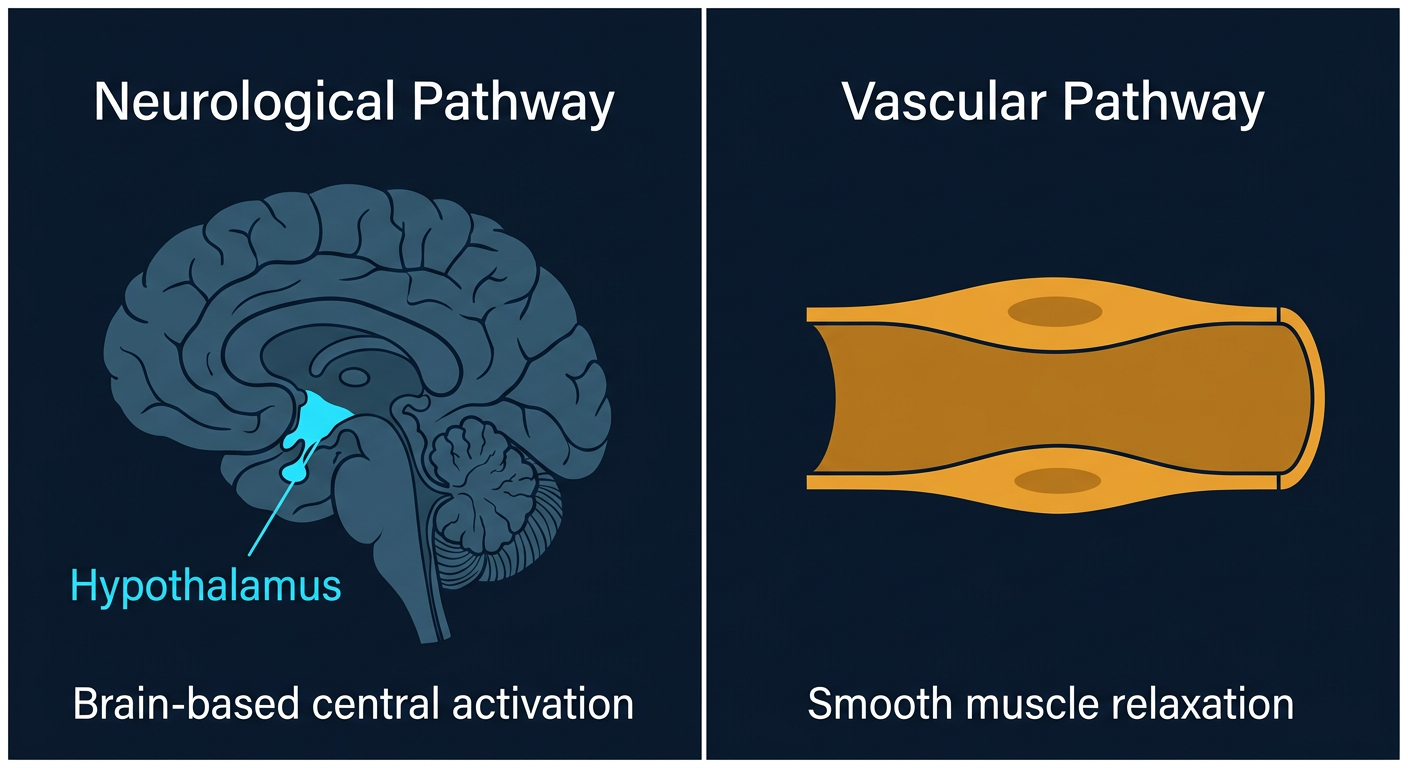
Central vs. Peripheral Mechanisms
The distinction between neurological and vascular sexual response mechanisms is clinically significant. These two classes of compounds act at entirely different anatomical and pharmacological levels.
Central
PT-141 / Bremelanotide
Activates hypothalamic MC4R receptors
Initiates top-down neural signaling
Engages limbic & dopaminergic pathways
Produces CNS-mediated arousal readiness
Onset: 30–60 min (subcutaneous)
Works regardless of stimulation context
Peripheral
PDE5 Inhibitors (e.g., Sildenafil)
Inhibits PDE5 enzyme in vascular smooth muscle
Increases cGMP → vasodilation
Enhances blood flow to genital tissues
Produces peripheral vascular response
Onset: 30–60 min (oral)
Requires sexual stimulation to activate
Section 03
Why Formulation Affects Cost
The price differential between nasal spray and injectable formulations reflects fundamental pharmacokinetic and manufacturing realities — not arbitrary markup.
Bioavailability Comparison
Approximate values based on published pharmacokinetic data
Bioavailability
Subcutaneous injection delivers near-complete bioavailability (~100%) by bypassing first-pass metabolism and gastrointestinal degradation. Nasal formulations show higher inter-individual variability due to mucosal absorption differences, nasal congestion, and ciliary clearance rates.
Concentration & Purity
Pharmaceutical-grade peptides require synthesis under strict GMP protocols with HPLC verification of >98% purity. Manufacturing complexity — including cyclization of the heptapeptide chain and lyophilization — contributes significantly to production cost.
Absorption Variability
Nasal mucosa has physiological variability: mucosal blood flow changes, secretion pH, and individual anatomy all affect absorption. Subcutaneous tissue provides a consistent depot environment, yielding more predictable pharmacokinetic profiles.
Regulatory Labeling
FDA-approved formulations undergo extensive stability testing, sterility validation, and pharmacokinetic profiling required for IND/NDA approval pathways. This development and compliance burden is reflected in end-product pricing.
Section 04
Two Attentional Styles in Intimate States
Neuroscience and cognitive psychology identify two distinct attentional modes that significantly influence intimate experience.
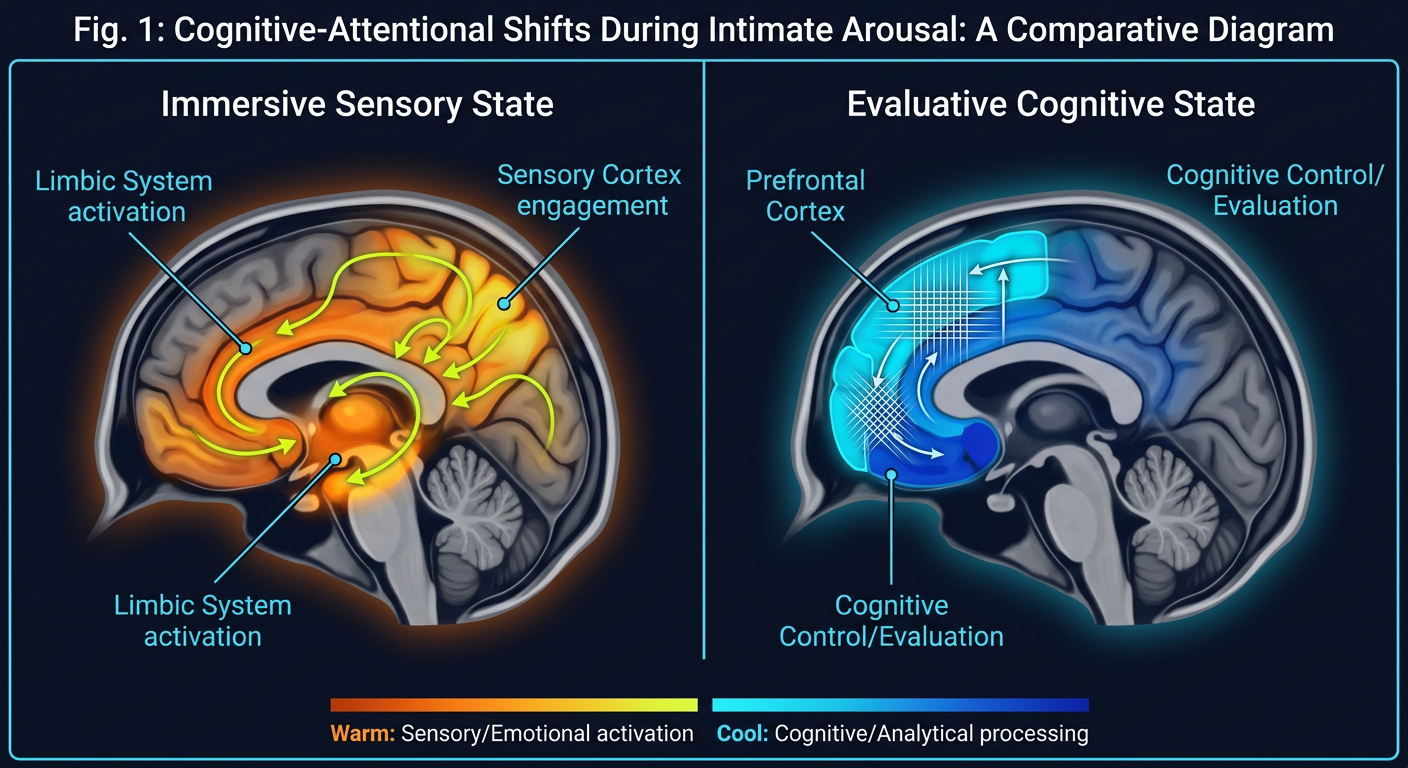
Immersive State
Sensory-Dominant
Sensory processing dominates cognitive bandwidth
Prefrontal executive function deprioritized
Reduced self-monitoring and performance evaluation
Heightened interoceptive awareness
Limbic engagement takes precedence
Associated with flow states and absorption
Evaluative State
Cognitive-Dominant
Prefrontal cortex activity elevated
Continuous performance monitoring active
Self-observation loop running in parallel
Reduced limbic engagement
Associated with anxiety and spectatoring
Attention directed outward or self-critically
Relevance to Central Arousal Research
Melanocortin receptor activation may influence the neurobiological threshold between evaluative and immersive attentional states. The hypothalamic circuitry engaged by MC4R agonism is anatomically positioned to modulate the limbic-prefrontal balance that underlies these attentional orientations. This is an active area of neuroscientific inquiry, not an established therapeutic claim.
Section 05
Clinical Research by Population
Clinical development of bremelanotide has proceeded primarily in female populations, resulting in FDA approval. Research in male populations is at earlier stages. No treatment promises are implied by this reference.
FDA-Approved Indication
Female Population
FDA approved for HSDD in premenopausal women (2019, Vyleesi®)
RECONNECT Phase III trials: statistically significant ↑ desire scores
Significant ↓ distress scores vs. placebo
Mechanism: central MC4R activation in PVN/MPOA
Does not require sexual stimulation to initiate response
Most studied population in clinical literature
Investigational Research
Male Population
Not currently FDA-approved for male indication
Phase II data demonstrated efficacy in psychogenic erectile dysfunction
May act on central desire circuitry independent of vascular mechanism
Studied in men with treatment-resistant ED (PDE5i non-responders)
Mechanism pathway similar: MC4R hypothalamic activation
Further clinical development ongoing as of 2024
Regulatory Development Timeline
Phase I data on intranasal formulation published in NEJM
FDA declines nasal formulation — blood pressure concerns
Subcutaneous reformulation Phase III (RECONNECT) initiates
FDA approves Vyleesi® (bremelanotide) for HSDD in premenopausal women
Ongoing research in male populations and HSDD in postmenopausal women
Section 07
Safety & Mechanism Integrity
A balanced reference on the known safety profile, contraindications, and regulatory context of bremelanotide. Professional oversight is indicated for any clinical application.
Common Observed Effects
Nausea (most common; ~40% in clinical trials)
Transient facial flushing and hyperpigmentation
Headache
Transient blood pressure increases
Injection site reactions
Contraindications (Per FDA Label)
Cardiovascular disease history
Uncontrolled hypertension
Concurrent organic nitrate use
High cardiovascular event risk
Response Variability
Individual MC4R expression levels vary
Metabolic rate affects plasma half-life
Comorbid conditions influence response
Psychological state modulates subjective experience
Regulatory Status by Region
USA: FDA-approved as Vyleesi® (HSDD only)
EU: Not approved as of 2024
Canada, Australia: Investigational use
Many regions: Unregulated research compound
Professional Oversight Required
Bremelanotide is a pharmacologically active compound with established adverse event profiles. Its use outside of supervised clinical settings carries meaningful risk. This reference does not constitute medical guidance. Consultation with a qualified healthcare provider is required for any clinical application.
Informational Only
This site is an educational reference. No content constitutes medical advice, diagnosis, or treatment recommendation.
No Products or Vendors
This site does not sell, promote, distribute, or affiliate with any compound, vendor, or supplier.
Professional Consultation
Consult a licensed healthcare provider before making any medical decision. Regulatory status varies by jurisdiction.